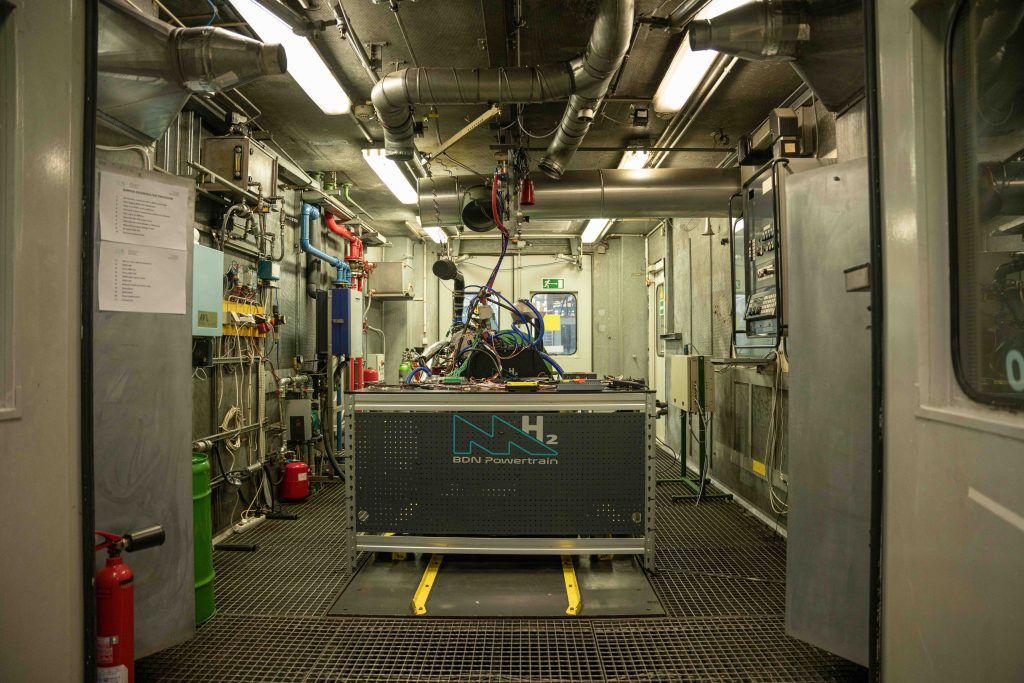
Our portfolio company, BDN Automotive Kft., a member of BDN Group, has signed a strategic cooperation agreement with MOL-LUB Kft., part of MOL Group. The partnership will focus on the development of hydrogen- and alternative-fuel engines, as well as related lubricant technologies.
Testing of BDN Powertrain’s hydrogen–diesel programme at the Budapest University of Technology and Economics (BME) achieved a hydrogen energy share of up to 83%. At the most favourable operating point in the emissions test series, fuel-consumption data indicated a calculated direct CO₂ reduction of approximately 78.5%.
The collaboration brings together MOL-LUB’s expertise in lubricant development, oil analysis and application engineering with BDN’s capabilities in engine development, engine control and combustion analysis. Shared priorities include evaluating engines and lubricants together, developing solutions that support reliability and durability, and preparing demonstration and pilot projects. For MOL-LUB, the partnership creates opportunities to develop lubricant technologies for alternative fuels using insights from actual engine operation.
BME is the programme’s university partner. The engine laboratory of its Department of Energy Engineering provided the testing location, dynamometer and emissions measurement infrastructure, and associated technical expertise. BME’s contribution enabled the assessment of engine performance, fuel consumption and emissions, directly connecting university research with the industrial application of a Hungarian-developed technology.
83% hydrogen energy share and substantial CO₂ reduction potential
The 83% peak achieved during development calibration means that hydrogen supplied 83% of the total fuel energy at that operating point. At the most favourable point in the emissions comparison, calculated specific CO₂ emissions fell from 894 to 192 g/kWh relative to diesel operation, a reduction of 78.5%. The weighted comparison reported for the eight-point test programme indicated a reduction of approximately 56%.
The programme’s primary future application is power generation, with a focus on reducing the carbon emissions associated with supplying electricity to industrial facilities and data centres through hydrogen-capable generator sets. Rail is the other priority, particularly converting existing diesel-powered rolling stock to hydrogen–diesel operation and reducing its emissions.
The programme is underpinned by the BDN Engine Development Platform, which combines simulation, digital twin models, combustion analysis and AI-assisted calibration. The hydrogen-diesel demonstrator is its first practical application, with the aim of reducing development time and cost and transferring the results to other engine platforms.
The system offers a pragmatic route to adopting hydrogen technology: users can trial the solution without making their operations wholly dependent on hydrogen supply. If hydrogen is unavailable, the equipment can continue running on diesel. This flexibility can support gradual adoption and accelerate the development of Hungary’s hydrogen ecosystem by creating real demand.
OUVC supports the project as its financing partner. Hiventures, an earlier investor in BDN, also contributed to the company’s development and the foundations for further innovation.